


















Newer
Celebrating Cycling Passion at a Mountain Event
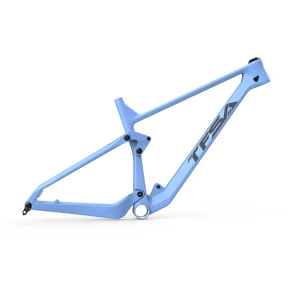
A full suspension mountain bike frame has to do much more than hold the wheels, suspension components, and drivetrain together. It is the structural foundation of the entire bike, influencing how efficiently power reaches the trail, how confidently the bike handles technical terrain, and how well it remains stable under repeated impacts.
Carbon fiber has become an increasingly important material for high-performance MTB frames because it allows manufacturers to control stiffness, weight, strength, and compliance more precisely than traditional metal construction. However, simply being made from carbon fiber does not automatically make a frame high quality. The real difference lies in the carbon material, layup design, molding process, suspension architecture, structural details, and quality control behind the finished product.
For riders, bike brands, and manufacturers evaluating an MTB full suspension carbon frame, understanding these factors is essential. A well-designed frame should provide a balanced combination of strength, stiffness, weight, durability, suspension performance, and manufacturing consistency.
The quality of the carbon fiber itself has a direct influence on the performance of the finished frame. Carbon fiber is available in different grades, fiber types, tensile strengths, and modulus levels. The choice of material affects how the frame responds to different loads and how much material is required to achieve the desired structural performance.
However, a high-quality frame is not necessarily one that uses the highest-modulus carbon available.
High-modulus fibers can provide excellent stiffness and allow designers to reduce weight, but they can also be less forgiving and more expensive. A practical frame design often combines different types of carbon fiber according to the requirements of each area.
For example, areas around the bottom bracket, head tube, suspension pivots, and rear shock mounts may require particularly strong and rigid structures. Other sections of the frame may benefit from a different combination of fiber orientations and material properties.
This is why the engineering behind carbon selection matters as much as the material specification itself.
One of the most important characteristics of a high-quality carbon MTB frame is the carbon layup.
Carbon fiber is inherently directional. Individual fibers provide their greatest strength and stiffness along their length, so manufacturers must carefully determine how each layer is oriented. A frame may contain fibers running in different directions to handle tensile, compressive, torsional, and impact loads.
A carefully engineered layup can reinforce specific areas without unnecessarily adding material throughout the entire frame.
The head tube, for example, experiences substantial steering and braking loads. The bottom bracket area must handle high pedaling forces and significant torsional loads. Suspension mounts experience repeated loading as the rear wheel moves through its travel. The chainstays and seatstays must also withstand a combination of impact, lateral, and fatigue loads.
A high-quality manufacturer therefore does not simply increase the number of carbon layers to make a frame stronger. Instead, the layup is optimized around the actual load paths of the frame.
This can produce a structure that is simultaneously lightweight, stiff where necessary, and sufficiently compliant in selected areas.

Stiffness is often associated with frame quality, but maximum stiffness is not always the objective.
An excessively stiff frame can transmit more vibration and impact energy to the rider, potentially making the bike feel harsh on rough terrain. At the same time, insufficient stiffness can lead to vague handling, unwanted flex during hard cornering, or inefficient power transfer.
A high-quality full suspension carbon frame therefore aims for controlled stiffness.
The front triangle typically requires strong lateral and torsional stiffness to maintain precise steering and tracking. The bottom bracket region also needs sufficient rigidity to support efficient pedaling. Meanwhile, certain parts of the rear triangle can be designed to provide controlled movement while still maintaining structural integrity.
This balance is particularly important for modern trail and enduro bikes, where riders may encounter everything from smooth climbs to high-speed descents and repeated impacts.
Carbon material and construction are only part of the equation. The geometry and suspension kinematics of the frame have an equally important role in determining how the bike performs.
A full suspension frame must work with the rear shock and linkage to control wheel movement throughout the suspension travel. Engineers need to consider factors such as anti-squat, anti-rise, leverage ratio, axle path, suspension progression, and pivot placement.
These characteristics influence how the bike behaves while pedaling, braking, cornering, and absorbing impacts.
For example, a well-designed suspension system can provide enough anti-squat to reduce unwanted suspension movement during climbing without making the rear suspension excessively firm over rough terrain. A progressive leverage curve can also help provide good small-bump sensitivity while maintaining support toward the end of the travel.
The frame’s geometry must work together with these suspension characteristics rather than treating them as separate design elements.
The suspension pivot system is one of the most mechanically demanding areas of a full suspension MTB frame.
Unlike a simple hardtail, a full suspension frame contains moving interfaces that experience repeated loading throughout every ride. Bearings, pivot hardware, linkage components, and surrounding carbon structures all need to maintain alignment and durability over time.
A high-quality design pays close attention to:
The carbon structure around the pivots is particularly important. If the load is concentrated into a small area, local stresses can become excessive. Engineers therefore use reinforcement and carefully designed interfaces to distribute loads into the surrounding frame structure.
Precision is also critical. Poor alignment can increase bearing wear, create unwanted friction, and affect suspension performance.
Some parts of an MTB frame consistently experience higher structural loads than others.
The head tube is subjected to steering forces, braking forces, impacts, and torsional loads. On aggressive mountain bikes, these forces can become significant when the front wheel lands heavily or the bike encounters large obstacles.
The bottom bracket area faces a different combination of loads. It must transfer pedaling forces into the frame while also supporting the drivetrain and suspension structure.
For these reasons, high-quality carbon frames typically use carefully engineered reinforcement around both areas.
A good design does not simply make these sections thicker. Instead, the carbon layup, tube shape, transitions, and reinforcement structures are designed together so that loads can be distributed efficiently.
Even an excellent engineering design can produce a poor frame if the manufacturing process is inconsistent.
Carbon composite manufacturing requires precise control of multiple variables, including fiber placement, resin distribution, temperature, pressure, curing conditions, mold accuracy, and component positioning.
During production, carbon layers must be placed according to the specified layup. Small deviations can potentially affect the structural characteristics of the finished part.
Mold quality is equally important. Accurate molds help maintain consistent dimensions and ensure that critical interfaces, such as headset seats, bottom bracket shells, pivot locations, and axle mounts, are produced within the required tolerances.
This is especially important for manufacturers producing frames for different bike models or customers. Consistent production is necessary to ensure that every frame behaves as intended rather than relying solely on a good prototype.
Carbon fiber provides the reinforcement, but the resin system binds the fibers together and transfers loads between them.
During composite manufacturing, controlling resin distribution is important because excessive resin can add unnecessary weight, while insufficient resin can compromise the integrity of the laminate.
Voids and other internal defects can also reduce structural performance. For this reason, professional carbon frame production focuses on controlling the molding and curing process to minimize internal imperfections.
Depending on the manufacturing method and product requirements, manufacturers may use processes such as compression molding, bladder molding, vacuum-assisted techniques, or other composite manufacturing approaches.
The objective is the same: achieve a consistent laminate with reliable fiber placement, controlled resin content, and strong bonding between layers.
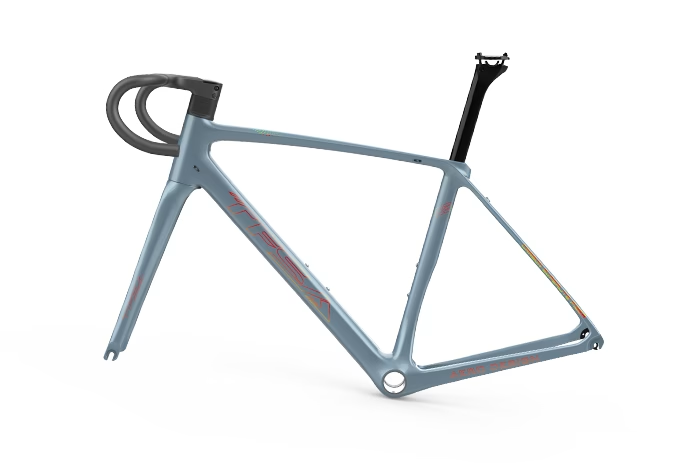
A visually attractive carbon frame does not necessarily indicate a high-quality product.
Glossy finishes, visible carbon patterns, smooth paintwork, and sophisticated graphics are easy for customers to notice, but many of the most important quality characteristics are hidden inside the frame.
A professional evaluation should therefore consider:
In other words, the quality of a carbon MTB frame should be judged by its engineering and manufacturing standards rather than its appearance alone.
One of carbon fiber’s biggest advantages is the ability to reduce weight while maintaining high structural performance. However, lightweight construction must be approached carefully.
A frame that is optimized only for minimum weight may not be appropriate for aggressive trail riding, enduro use, or riders who regularly encounter hard impacts.
The correct approach is to identify where material can safely be removed and where additional reinforcement is necessary.
For example, unnecessary material in relatively low-stress areas may be reduced, while high-load regions receive additional reinforcement. This creates a more efficient structure instead of simply making the entire frame thinner.
For an MTB full suspension carbon frame, the appropriate weight target should therefore be considered alongside the intended riding category, suspension travel, wheel size, rider weight range, and expected terrain.
Mountain bike frames experience thousands of loading cycles during normal use. Even when individual impacts are within the frame’s design limits, repeated loading can gradually reveal weaknesses in a structure.
This makes fatigue resistance an important characteristic of a high-quality carbon frame.
A well-engineered frame should be designed around the expected load spectrum rather than a single maximum impact. Engineers need to consider repeated pedaling loads, braking forces, suspension movement, cornering, landing impacts, and vibration.
Testing can help identify potential weaknesses before a frame enters production. Depending on the manufacturer and applicable standards, this may include static load tests, fatigue tests, impact testing, and other structural evaluations.
A carbon frame may be structurally strong but still cause problems if its interfaces are poorly manufactured.
The headset, bottom bracket, rear axle, derailleur mount, brake mount, pivot hardware, and other mounting points all need to meet appropriate dimensional requirements.
Small dimensional errors can result in:
For manufacturers and bike brands, dimensional consistency is particularly important because frames must work reliably with commercially available components.
Internal cable routing has become common on modern MTB frames because it creates a clean appearance and can protect cables from mud, water, and external damage.
However, completely internal routing can also make maintenance more difficult if it is poorly designed.
A high-quality frame should provide a practical routing system that keeps cables secure without creating unnecessary bends or complicated installation procedures. Clear routing paths, suitable entry and exit points, and appropriate internal guides can significantly reduce assembly and maintenance time.
For OEM and aftermarket frame manufacturers, serviceability is worth considering during the design stage rather than treating it as an afterthought.
Mountain bikes operate in harsh environments. Mud, water, dust, stones, and repeated impacts can all affect the frame and its components.
A quality frame should therefore consider environmental exposure as part of the overall design.
Drainage provisions can help prevent water accumulation inside the frame. Sealed bearing areas can reduce contamination. Chainstay and downtube protection can help limit damage caused by chain slap and rocks.
These details may not dramatically change the specifications on a product page, but they can have a meaningful effect on long-term ownership.
A strong engineering team can create an excellent frame prototype. Producing hundreds or thousands of consistent frames is a different challenge.
Quality control should be integrated throughout the production process rather than relying entirely on final inspection.
Important quality-control stages may include:
This process helps manufacturers identify problems before products reach customers and, equally importantly, helps maintain consistency between production batches.
When comparing different frames, looking at weight alone is rarely enough. A better evaluation considers the entire engineering package.
Ask the following questions:
What type of carbon fiber is used?
The material specification should be clear enough to understand the intended balance between stiffness, strength, and weight.
How is the carbon layup engineered?
The manufacturer should understand how loads move through the frame and reinforce critical areas accordingly.
What riding category is the frame designed for?
A lightweight XC frame and an aggressive enduro frame have very different structural requirements.
How is the suspension system designed?
Geometry and kinematics strongly influence climbing efficiency, traction, braking behavior, and descending performance.
What testing is performed?
A professional manufacturer should have a defined testing and inspection process rather than relying solely on visual checks.
How consistent is production?
For brands and OEM customers, repeatability is just as important as the performance of an individual prototype.
Are replacement and service requirements considered?
Bearings, pivot hardware, cable routing, and frame protection should all be practical for long-term use.
There is no single characteristic that makes an MTB full suspension carbon frame high quality.
A premium frame is the result of many engineering decisions working together. High-quality carbon materials need to be combined with an appropriate layup. The layup must work with the frame’s geometry and suspension kinematics. Critical areas require sufficient reinforcement, while unnecessary material should be eliminated to control weight.
At the same time, manufacturing processes need to be repeatable, dimensions need to remain within tight tolerances, and finished frames need to undergo appropriate quality inspections and testing.
For riders, this balance translates into more predictable handling, efficient power transfer, controlled suspension performance, and confidence on demanding terrain. For bike brands and OEM customers, it also means greater production consistency and fewer problems during assembly and long-term use.
Ultimately, the quality of a carbon full suspension MTB frame cannot be determined simply by its appearance or a low frame weight. Material selection, carbon layup, suspension engineering, structural reinforcement, manufacturing precision, durability testing, and quality control all contribute to the final result.
That combination of engineering and manufacturing discipline is what turns a carbon frame from a lightweight component into a dependable foundation for a high-performance mountain bike.


