




















Newer
How to Develop a Custom Carbon Fiber Road Bike Frame
Customizing a lightweight carbon road frame requires clear performance targets and practical engineering decisions. For bicycle brands, the challenge is to reduce weight while maintaining stiffness, handling, durability, and component compatibility.
A structured development process helps buyers evaluate materials, geometry, tooling costs, and manufacturing quality before approving a frame for production.
Reducing frame weight can improve climbing performance and make a bicycle easier to accelerate. However, excessive material removal may compromise structural integrity. Weight targets should account for frame size, intended use, rider weight limits, and applicable safety requirements.
Stiffness influences how a frame responds to pedaling, steering, and cornering forces. The bottom bracket, head tube, and rear triangle require different structural considerations because they experience different loads.
Engineers should evaluate stiffness alongside weight and fatigue resistance rather than treating low mass as the only performance objective.
The intended application determines the main design priorities. Climbing frames emphasize low mass, endurance models prioritize fit and stable handling, and aero road frames focus on reducing aerodynamic drag.
| Performance goal | Design priority | Key consideration |
| Climbing | Low frame weight | Material distribution |
| Endurance | Rider comfort | Geometry and tire clearance |
| Road racing | Responsive handling | Frame stiffness |
| Aero racing | Reduced aerodynamic drag | Tube profiles |
These priorities provide a starting point. Actual performance also depends on rider position, components, and riding conditions.
Carbon fiber grades differ in tensile strength, modulus, processing characteristics, and cost. These properties influence design options, but fiber grade alone cannot predict the performance of a finished frame.
For example, published values for specific T800H and T1000G fibers show tensile moduli of approximately 294 GPa, with reported tensile strengths of approximately 5,490 MPa and 6,370 MPa, respectively. These figures describe specific fiber grades rather than complete composite structures. Resin systems, fiber orientation, laminate thickness, and manufacturing quality also affect the finished frame.
Material selection should reflect the intended performance target, production process, and budget.
Carbon layup determines how fibers are arranged to resist different loads. Longitudinal fibers support loads along a tube, while angled and transverse layers help manage torsional forces and local stress.
Combining fiber grades may help meet specific design requirements, but stronger fibers do not automatically produce a lighter frame. Any material reduction requires engineering assessment and physical validation.
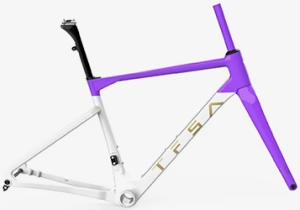
The lightweight carbon road frame JH 35 has a listed unpainted weight of 680 g. Before using this figure as a benchmark, confirm the applicable frame size, weight tolerance, and material specification.

Stack and reach help define the rider’s position on the bicycle. Seat tube angle and effective top tube length also influence fit and pedaling position.
Brands should establish target rider profiles and sizing requirements before selecting geometry. This reduces the risk of developing a frame that meets weight targets but fails to suit its intended customers.
Head tube angle, fork geometry, chainstay length, and bottom bracket drop influence steering response and handling. Their effects should be evaluated together rather than changed independently.
Climbing and racing models may use geometry that prioritizes responsive handling, while endurance models may emphasize stability. The appropriate configuration depends on the intended riding style and complete bicycle design.
Geometry changes across frame sizes can affect fit, weight distribution, and handling. Brands should review the complete size range instead of assuming that one size can represent the entire series.
Computer aided checks help identify potential design conflicts, while sample evaluation provides an opportunity to verify fit, component clearance, and handling characteristics.
Brake configuration affects frame design and component interfaces. Buyers should specify disc or rim brakes before mold development because changing the brake system later may require structural or dimensional revisions.
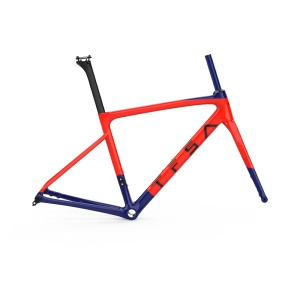
The carbon rim brake road frame JH 06 is one reference for a rim brake design. Its official specifications list T800 carbon fiber, internal cable routing, and BSA/BB68 threaded bottom bracket compatibility. The listed unpainted weight is 800 g for the 44 cm size. Confirm the latest specifications before using the model as a development reference.

The bottom bracket shell must match the intended crankset and bearing system. Buyers should confirm the required standard, shell dimensions, and compatibility with the selected components before approving the frame design.
This information should be included in the technical specification to reduce assembly problems during sample evaluation.
Tire clearance depends on tire width, rim dimensions, wheel configuration, and manufacturing tolerances. A frame designed for narrow road tires may not accommodate wider tires without changes to the frame or fork.
Specify the intended wheel and tire combination during the engineering review to prevent interference during assembly and use.
Before sampling, document the target weight, geometry, material requirements, component standards, branding, and intended application. The manufacturer can then assess feasibility and identify any conflicts before production begins.
A complete specification also provides the basis for checking the sample and approving the final design.
Evaluate the sample against the approved requirements. Relevant checks include weight, dimensions, surface finish, component fit, and structural performance.
Where applicable, ISO 4210 testing should be included in the validation plan. ISO 4210 6 specifies test methods for bicycle frames and forks within the relevant safety requirements framework. Confirm the applicable requirements for the intended bicycle category and request test documentation for the actual design.
Consistent production depends on controlled material handling, fiber placement, curing conditions, and inspection procedures. A quality plan should define material identification, batch traceability, dimensional checks, and acceptance criteria.
These controls help manufacturers identify variation between samples and production units and provide buyers with a clearer basis for supplier evaluation.
Tooling, material selection, layup complexity, finishing, testing, and order quantity all affect the final price. For a project specific quotation, contact the engineering team through the official carbon frame customization services page with your target specifications and expected order volume.
The schedule depends on mold availability, sample production, testing, design revisions, and production capacity. Request a project specific timeline after the technical requirements have been reviewed.
Service life depends on structural design, manufacturing quality, riding loads, impact history, and maintenance. Buyers should review relevant test documentation, declared usage limits, and warranty terms rather than judge durability by frame weight or fiber grade alone.
Customizing a lightweight carbon road frame requires clear performance targets, suitable materials, and compatible components. Detailed specifications help brands assess design feasibility and reduce unnecessary revisions.
To discuss your project requirements, expected order volume, and customization options, contact the TFSA Bike team for a tailored development plan.


